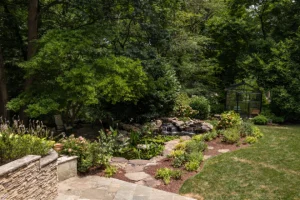

Did you build your pond yourself, or buy a house with one already in the yard, and now it leaks, turns green, or just isn’t right? A big part of whether you patch it or rebuild it is whether the pond shell itself still holds water.
You’ll learn:
- How to tell whether a failing pond needs a repair or a rebuild
- Why DIY and kit ponds fail
- What an exploratory drain and clean shows
- What a rescue involves and how long it takes
- How fish stay safe during a rebuild
- What keeps a rescued pond clear
- Whether an inherited pond can be brought back
How Do I Know Whether My Pond Can Be Repaired or Has to Be Rebuilt?
Start by noticing when the water level drops. If the pond shell itself is leaking, you could be looking at a full rebuild right away. That’s not common, though. 9 out of 10 active leaks we see happen while the waterfall or pumps are running, not while the pond sits still. A hole in the liner of the shell is pretty rare, believe it or not.
So if your pond only drops while the pumps run, the leak is somewhere in the waterfall or the plumbing, and the shell itself is holding water. Our leak test starts with turning everything off, and you can read more about pond leak detection on our site.
When a pond is in dire straits, it goes to a renovation. Otherwise, we start with an exploratory cleaning to figure out what’s going on and get the pond back to square one.
Why Do So Many DIY and Kit Ponds Fail?
A lot of times, the problem is how the pond was installed. Materials can play a part too.

DIY generally gets done to save money. That means a lower-grade liner, lower-grade plumbing, and no padding to put down before the rocks go on the liner. Then a rock tears the liner, which is easy to miss if you haven’t built a pond before.
The padding DIY builds skip is the underlayment. On our builds, it goes under the liner, and the liner is what holds in the water.
What Else Usually Goes Wrong in a Pond That Fails?
Here’s what else we find when a pond fails:
- A super thin liner tears during the build and leaves a stream leak.
- The liner edges get cut too short, which every pond builder has done at some point, and there isn’t enough liner to keep the water in.
- Seals around filters fail.
- Tree roots break through, or hardware corrodes and falls apart and causes leaks.
What Does an Exploratory Drain and Clean Involve?

An exploratory pond cleaning is a full drain and clean on a pond that hasn’t had one in at least a few years. We drain it down, power wash it, and get all the slop out. Then we figure out what’s working and what’s not, identify what the pond is missing, and make recommendations. It’s almost always where we start nowadays. You can see how it works on our exploratory drain and clean page.
When the muck is too thick for a machine to handle, the crew builds a bucket brigade and pulls it all out by hand, in an assembly-line fashion.
What Does It Take to Rescue a Failed Pond?

How much gets rebuilt depends on what the drain shows. On one large rescue, the pond had not been touched in many years and was lacking filtration, and its old pumps wouldn’t prime. We installed a BioFalls 6000 and a short stream at the top of the biggest waterfall and added a huge plant package. It took about 4 or 5 days and came in around $30,000.
A smaller renovation went faster. The old pond was really dirty and had no filtration, so we ripped it all out, made it a little bigger, and added a BioFalls 2500 and a pump, plus a fish cave. It took 3 days.
| Job | What changed | Time |
|---|---|---|
| Untouched pond lacking filtration | BioFalls 6000, short stream, and big plant package | About 4 to 5 days |
| Old pond with no filtration | New BioFalls 2500, pump, and fish cave | 3 days |
Our pond repair and renovation service covers both the small fix and the full rebuild.
How Do You Keep My Fish Safe While the Pond Is Rebuilt?

3 main things kill fish: temperature shock, pH shock, and toxins or chlorine. So during a renovation, your fish stay in all of their own water. We pump the water out of your pond into a tub. Getting the fish out is low-tech: we take the water level down, and then it’s net after net after net of fish, and they hang out in the tub while we work.
If that water is in really bad shape, we dilute it very slowly over the course of the project, so the fish don’t get pH or temperature shocked. Take fish out of a pea-soup green pond and put them in a tank of brand-new water, and they’ll get pH shock.
Chloramine and other disinfectants in tap water can be harmful to fish too.
What Keeps a Rescued Pond From Turning Green Again?

Fish and debris keep putting nutrients in, so something has to take them out. Filters capture the debris, and beneficial bacteria break it down, but an aquatic plant load does even better than that. We like to see 50 to 70 percent surface coverage of aquatic plants, because that means plenty of root mass to absorb nutrients from the water and keep it healthy and clear.
Rock and gravel help too. They give beneficial bacteria a place to grow on every surface, and they give debris a place to collect rather than float in your water.
Can an Inherited Pond Be Brought Back?
Not every pond we bring back was built by the homeowner. Sometimes you bought the house and the pond came with it, and it isn’t looking its best.
A big part of our business is coming across an old pond that a new homeowner inherited, then doing a small renovation like adding a skimmer and a filter.
Where Do I Start If My Pond Is Failing?
Start by finding out what’s actually under there before you spend anything on patching it. If you’re not sure whether you need pond repair or a rebuild, send us a few photos through our site and we’ll start there.