If you live in Howard County and want a koi pond in your backyard, here is what the build involves and how your yard changes it.
You’ll learn:
- How a Howard County yard changes a koi pond build
- Why homeowners here want a koi pond
- How a koi pond gets built, from spray paint to fill-up
- What keeps the water clear and the fish healthy
- What to decide before the crew arrives
Is Building a Koi Pond in Howard County Any Different?
In Howard County, lots tend to be spread out, and access isn’t usually an issue. If your lot is tight, the build might cost a little more than it would in a wide-open backyard, but it’s totally possible.
Soil is the bigger variable. Where we’re based in Glenwood, the soil is all clay, and that’s pretty prevalent in Maryland.
We pretty much always count on having a jackhammer running for digging, because about 50% of the time you need one. Our post on how we handle hitting rock in the dig covers that part.
If your pond is going in at the bottom of your yard and the soil is all clay, we plan for hydrostatic pressure, which is water building up in the ground around the pond.
The parts we put in and the process we follow are the same from pond to pond. The shape and form are a bit different each time. Every yard has its own wrinkles, and working them out is part of the job.
Why Do Howard County Homeowners Want a Koi Pond?

Western Howard County is more like farmland, and people there are usually more in touch with nature. Eastern Howard County is a little more city-like, so people there want to bring nature in.
A pond gives a family a destination, and that makes it a lot easier to pry the kids away from the TV.
How Does a Koi Pond Get Built, From Spray Paint to Fill-Up?
A koi pond gets built in this order: a spray-paint layout, the dig, shelves, the liner, rock, the filter, fill-up, and plants. By the time we come out, there’s not a lot of figuring out left to do. The pond kit comes in with the size liner we need, and the rocks to fill that liner come in too.
In Maryland, whoever is digging should call 811 at least 2 full business days (but no more than 10 days) ahead so utility lines get marked. After that, the build starts on the ground with spray paint.

Spray paint is the fastest way to show everyone exactly where the pond is going and how big it will be. The pink line marks where the hole will be dug to, not the water surface you’ll see.
The rock that goes in over the liner can change the shape a little. The build goes in this order:
- Dig the hole to the painted line.
- Build the shelves: a deepest point where the pump can be dropped during maintenance, and plant shelves at the height where aquatic plants sit best in the water.
- Lay the underlayment, which is the padding for the liner, and then the liner, which is what holds the water.
- Set the rock, starting at the lowest depths and working up.
- Set the BioFalls, a mechanical and biological filter, at the head of the stream.
- Fill the pond and let it run overnight to check for leaks, then drain it, finish the rock, and set the plants.
Our demo pond in Howard County is our practice pond, and we get to rebuild it every year. In this video, the crew builds the shelves, lays the liner, sets the rock from the bottom up, and sets the BioFalls.

This pond is at step 4: the liner is in, and the rock is going in over it, with the waterfall rock stacked at the back.
On average, we’re on site 3 to 5 days, with bigger jobs taking longer. Your crew lead checks in with you at the beginning and end of each workday to tell you what’s about to happen or what just happened.
At the end, your crew lead gives you a final walkthrough and their card with an email and phone number. It’s your chance to ask all your questions before you take over the pond.
What Keeps a Koi Pond Clear and the Fish Healthy?

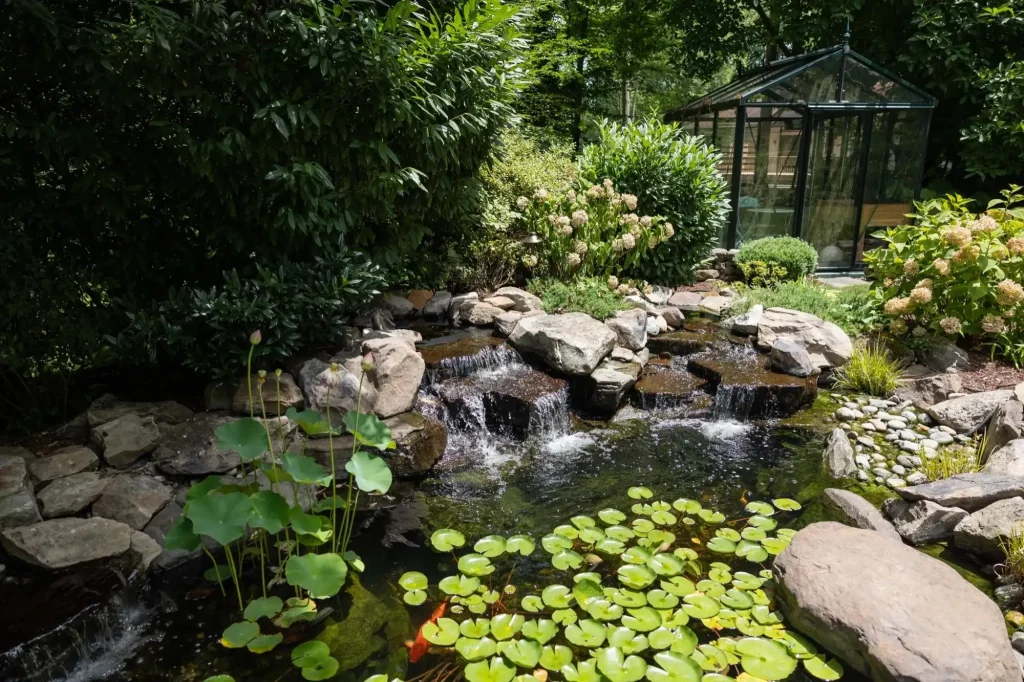
A proper aquatic plant load, like the water lilies and tall edge plants in this pond, is the biggest key to clear water.
5 things keep a koi pond healthy:
- Terraces. We terrace the pond, with shelves at different depths for different plants and for the fish.
- A biological filter and a skimmer. A koi pond needs both to take debris out of the water.
- Rock and gravel. They give beneficial bacteria a place to grow on every surface, and those bacteria help break down fish and plant waste. They also give debris a place to collect instead of floating, and protect the liner.
- Plants. We like to see 50 to 70% of the surface covered. The roots soak up nutrients, and the plants shade the water from UV rays, so less algae grows.
- Fish tunnels. There are a lot of herons around Washington, D.C. and Baltimore, and they hunt koi. A tunnel is a hard plastic tube with rocks all around it, and it gives the fish a place to hide.
What Should I Decide Before the Crew Arrives?
Size is the main thing to decide. The biggest piece of feedback we get from our customers is, “I wish I had made it bigger.” A bigger pond has room for add-ons, like a giant stream off the back of the pond or 20 lights.
You may have a few decisions along the way, like how to orient the waterfall or how many lights you want.
Plants and fish come as separate packages from the pond itself. For what a pond costs, see our pond construction costs page.
Ready to Plan Your Koi Pond With Premier Ponds?
The first step is a phone consult, followed by a free job walk. To see how we build, read about our new koi pond construction, or give us a call.


